

You are required to tee up your ball behind the front edge & in-between the outside boundaries of the tee markers and up to 2 club lengths of your longest club back of the markers. Your feet do not have to be in-between the markers. If you tee off ahead of the markers or outside the 2 club length distance behind markers, you incur a 2 stroke penalty.

You must play the ball “as it lies” which means you may not touch the ball or move the ball so it sits better on the grass or sand or receive a one-stroke penalty. Beginner golfers should take liberties with this rule and improve how the ball sits as you see fit until you develop some confidence hitting the ground in the right spot (low point) and a good golf swing movement pattern. You just won’t be able to play in club events or establish an official handicap yet.
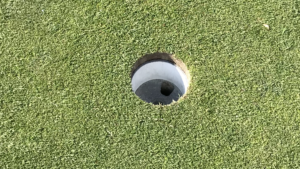
The golf ball must finish inside the hole or cup to be official. Often times your friends will “give” you a putt inside a few feet as a courtesy but playing tournament golf the golf ball must be holed-out to be official or the player will be assessed a 2 stroke penalty or disqualified from the event.

The Rules of Golf state you are only allowed 3 minutes to look for a lost ball or receive a 2 stroke penalty to help keep the pace of play on the golf course.
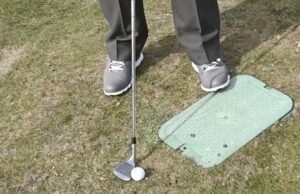
If your golf ball rests on, or your stance is hindered by standing on, a cart path or sprinkler head or something man-made you get a free drop where both your stance & ball are given relief no closer to the hole.

You are allowed to remove sticks, grass, pine cones or other loose impediments from around your ball as long as when you do your ball does not move, so be careful or you will incur a one-stroke penalty and will have to call the penalty on yourself as no one will likely see the ball move except you. This honor system is one of the greatest aspects of golf.

You must use a flat object such as a coin or ball marker and place it directly behind the golf ball with as little space between the ball marker and ball without touching the ball. You may not place the marker in front of or to the sides of the golf ball.
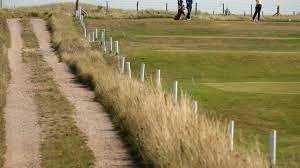
“Out of bounds” refers to those areas outside the golf course from which play is not allowed, or any area designated as out of bounds by the golf course. Out of bounds is marked by white stakes or some type of barrier like a fence or wall.
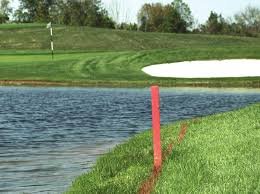
A “lateral water hazard” is a water hazard or part of a water hazard that runs alongside or parallel to the golf hole. These hazards are positioned where you cannot find a direct line from behind the hazard to the pin so you drop the ball 2 club lengths from the point the ball entered the hazard no closer to the hole.
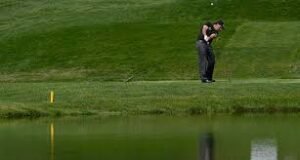
When a golfer hits their ball in a yellow-stake water hazard, the golfer has two options to drop the ball, take relief and incur a one-stroke penalty: Drop the ball behind the water hazard, keeping the point where the original shot went in the water hazard between where the golfer drops and the hole.
If your ball lies within a red or yellow stake hazard you may let your club touch the ground, take practice swings, touch the water, remove loose impediments for no penalty, as well as pick up the ball and take relief for a one-shot penalty.

A sand trap or bunker is considered a hazard designed to penalize the golfer for lack of accuracy. If your golf club touches the sand of a bunker you will receive a one shot penalty stroke. However, you can move sticks or other loose impediments as long as you don’t touch or move your ball. Also, you can’t touch the sand or make practice swings to test the surface, so you must feel it with your feet.

If you accidentally move any player’s ball (even your own) while searching for it OR on the putting green there is no penalty, just replace the ball in its original spot.
If your driver accidentally knocks the ball off the tee, there is no penalty.
You may declare the lie, or how your ball sits, unplayable anywhere on the golf course and receive a one-shot penalty for relief. You have 3 options: 1) Go back to the original spot you hit from and play the shot again. 2) Drop your ball 2 club lengths from the unplayable spot no nearer the hole (this is the most common choice). 3) Drop the ball as far back as you want from a straight line between the unplayable spot and the flag.

You may repair most damage on a putting green such as spike marks, ball marks, and animal or people damage.